×
Property Insights

EC vs Condo in Singapore

Choosing between an Executive Condominium and a private condo is not just about price. It also comes down to eligibility, ownership flexibility, rental restrictions, and your long-term property goals.

A Practical Comparison for Singapore Buyers

Many buyers compare ECs and condos because both offer condominium-style living, but they are not the same. An EC can offer stronger value at entry for eligible households, while a private condo may offer more freedom and flexibility from the start.

Executive Condominium

EC

Why Buyers Consider ECs

  • Usually lower entry price than comparable private condos
  • Can be attractive for eligible HDB upgraders
  • Modern facilities and newer product positioning
  • Potential value upside as the project matures

What to Watch Out For

  • Income ceiling applies
  • Family nucleus is generally required
  • Ownership rules are more restrictive in the earlier years
  • During the 5-year Minimum Occupation Period (MOP), the owner must live in the unit and cannot rent out the entire apartment, although renting out bedrooms is allowed subject to HDB rules.
  • Not every EC is automatically a strong investment — project selection still matters
Private Condominium

Condo

Why Buyers Consider Condos

  • No income ceiling
  • No EC eligibility restrictions
  • Immediate private ownership
  • Greater flexibility for rental, ownership structure and future plans
  • No MOP-based rental restriction, giving owners greater rental flexibility from the outset.

What to Watch Out For

  • Usually higher entry price than ECs
  • Larger upfront financial commitment
  • Not all condos offer equal value — location and project quality matter greatly
  • Buying private does not automatically mean better long-term returns

Who This Comparison Is Most Useful For

This guide is particularly helpful for buyers deciding between entry value and ownership flexibility.

HDB Upgraders

If you are moving from an HDB flat and comparing ECs with private condos, understanding the differences in pricing and eligibility can help clarify your options.

Eligible Family Buyers

If your household qualifies for an EC, comparing it with private condos can help determine whether the lower entry pricing outweighs the restrictions.

Buyers Seeking Flexibility

If ownership flexibility and fewer restrictions matter more to you, private condominiums may be the better fit.

Questions Buyers Commonly Ask

These are some of the most common questions people search when deciding between an EC and a condo in Singapore.

Should I buy an EC or a condo in Singapore?

If you are eligible for an EC and want stronger entry value, an EC may be worth serious consideration. If you want immediate private ownership, fewer restrictions and greater flexibility, a condo may suit you better. The right choice depends less on labels and more on your timeline, budget and long-term plans.

Is an EC cheaper than a condo?

In many cases, yes. ECs are often priced lower than comparable private condominiums at entry. That is one reason many eligible families view ECs as a more attractive stepping stone into the private housing segment. However, price alone should not drive the decision — location, project quality and exit potential still matter.

Who Can Buy an EC in Singapore?

Executive Condominium buyers must meet eligibility conditions set by the government, typically relating to household structure, citizenship and income ceiling requirements.

Because of these rules, ECs are generally more selective than private condominiums. Buyers who do not meet the eligibility criteria — or who prefer fewer restrictions — may instead consider private condominiums.

If you would like a more detailed explanation of EC requirements, including income ceilings, family nucleus rules and Minimum Occupation Period conditions, you can read the full guide here: Executive Condominium Eligibility in Singapore.

Is an EC a good investment?

An EC can be a strong option when bought well, especially if the entry pricing is attractive and the project has good location fundamentals. But not every EC is automatically a good investment. Factors such as nearby competition, future supply, accessibility, demand profile and overall project positioning still play a major role.

Can you rent out an EC?

Executive Condominium owners must live in the unit during the first five years after purchase (the Minimum Occupation Period). During this time, renting out the entire unit is not allowed, although bedrooms may be rented out subject to HDB regulations.

Private condominiums do not have the same MOP-based restriction, which means owners generally have more flexibility to rent out the property from the outset.

Is a condo better for flexibility?

Yes, in general. A private condo does not come with EC-specific eligibility rules, and that makes it more flexible from the outset. Buyers who want immediate private ownership, broader ownership options or greater rental flexibility may prefer a condo even at a higher entry price.

Which is better for HDB upgraders?

For many eligible HDB upgraders, an EC can offer a useful balance between affordability and private-housing aspirations. But some upgraders may still prefer a condo if they value location, immediate ownership flexibility, specific lifestyle factors or a project that better matches their long-term strategy.
How Should Buyers Compare EC and Condo?

The better choice is not just about price. It is about how the property fits your eligibility, timeline, affordability and intended holding strategy.

EC May Suit Buyers Who Prioritise

Value

Condo May Suit Buyers Who Prioritise

Flexibility

A useful way to compare the two is this: ECs can appeal strongly when you qualify and want stronger entry value, while private condos may appeal more when flexibility, freedom of ownership and fewer restrictions matter more to you.

EC vs Condo Price Trends

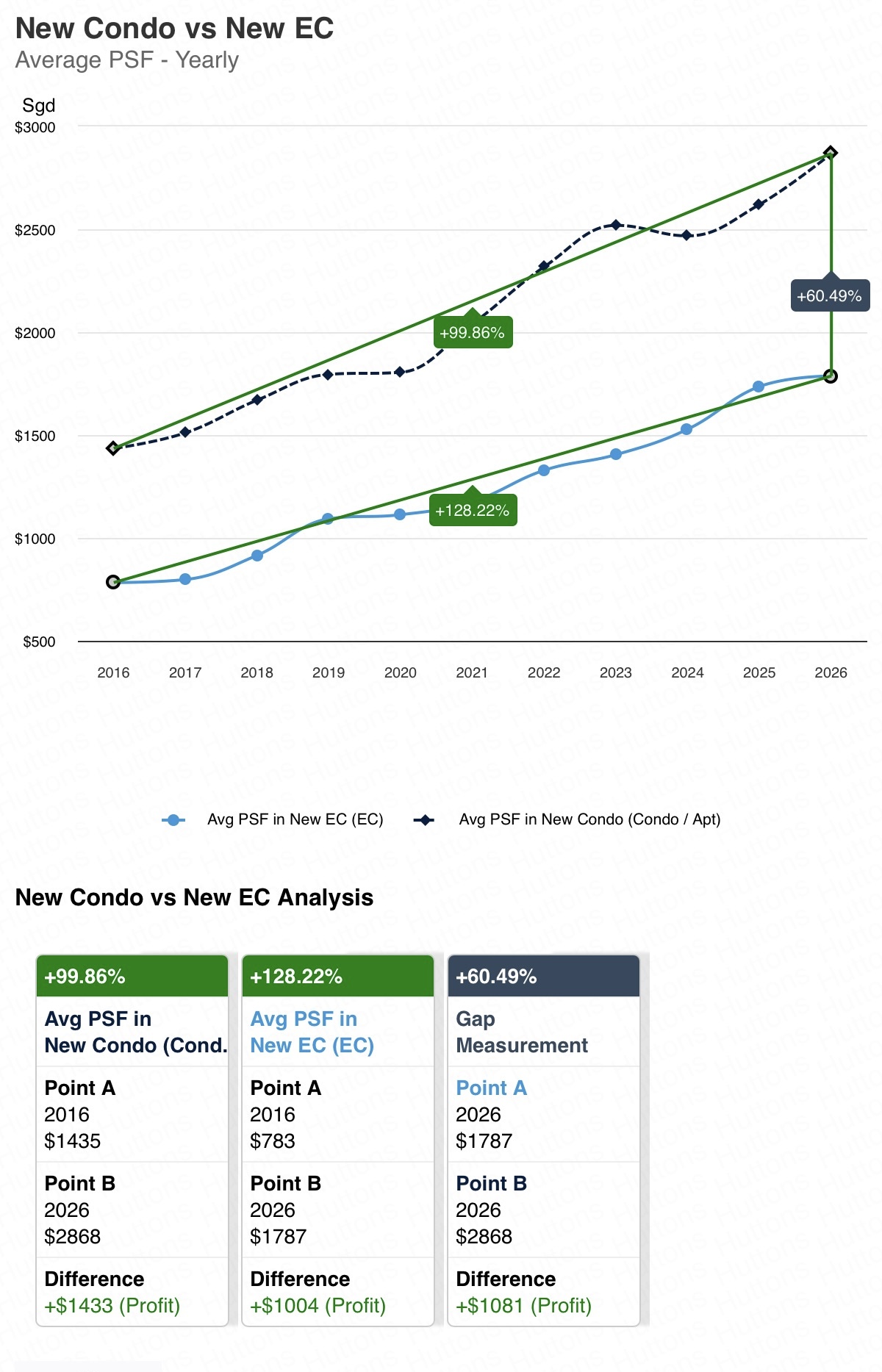
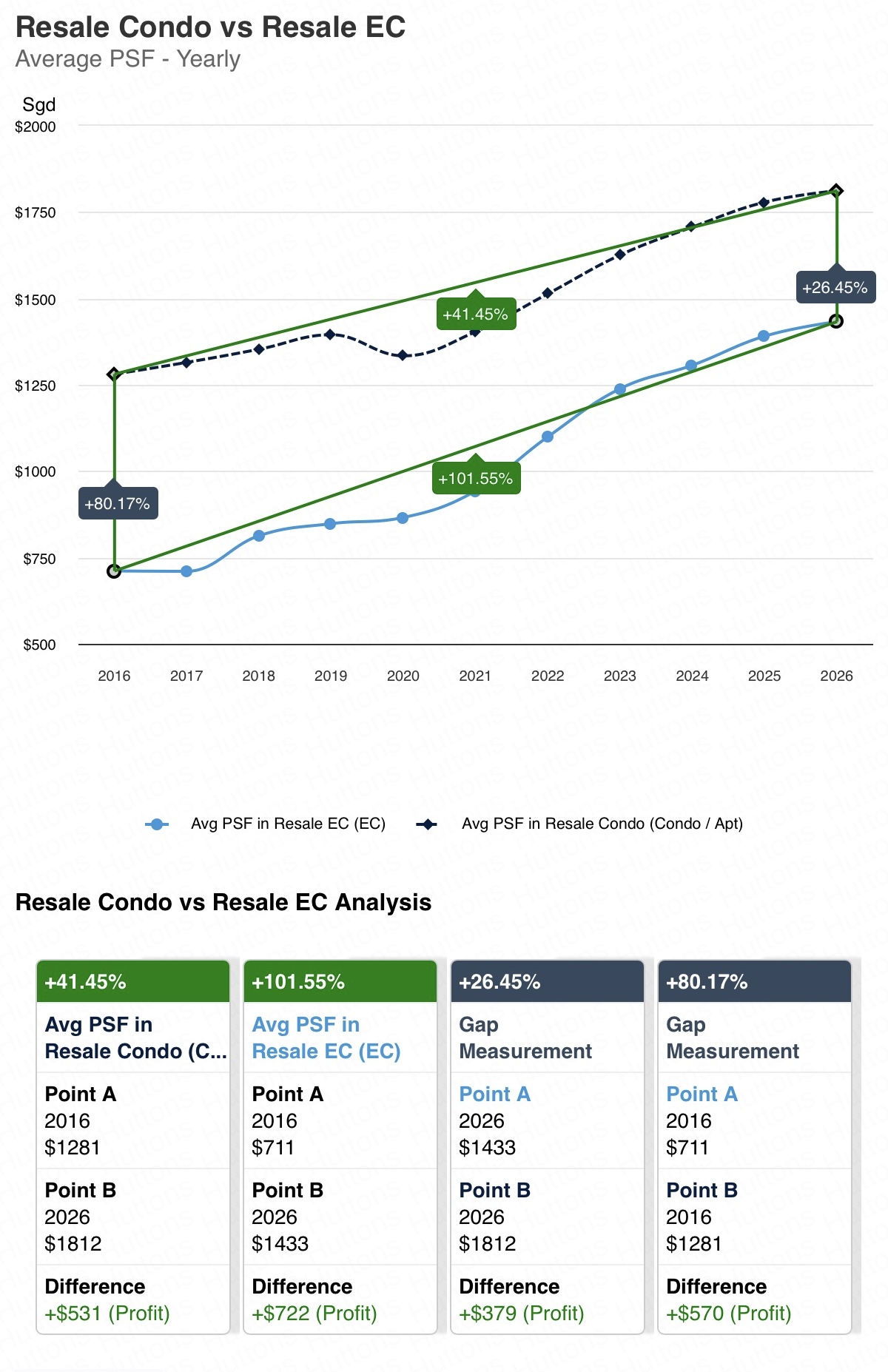
Comparing new launch and resale data over the 10-year period from 2016 to 2026 highlights how ECs typically start at a lower entry price, with the gap to private condominiums gradually narrowing over time.

Average PSF yearly comparison between new Executive Condominiums and new private condominiums in Singapore
Average PSF yearly comparison between resale Executive Condominiums and resale private condominiums in Singapore

New Condo vs New EC

This chart compares the price growth of newly launched Executive Condominiums (ECs) and private condominiums.

  • New private condominiums increased from about $1,435 PSF in 2016 to $2,868 PSF in 2026.
  • New Executive Condominiums increased from about $783 PSF to $1,787 PSF over the same period.
  • This represents roughly +99.86% growth for private condos and +128.22% growth for ECs.

Executive Condominiums typically launch at lower prices because they are designed to support middle-income homebuyers. As a result, ECs may record stronger percentage growth over time as prices gradually move closer to nearby private condominiums.

Resale Condo vs Resale EC

The resale market comparison shows how the price gap between ECs and private condominiums may narrow over time.

  • Resale private condominiums increased from around $1,281 PSF in 2016 to about $1,812 PSF in 2026.
  • Resale EC prices increased from about $711 PSF to around $1,433 PSF over the same period.
  • This represents roughly +41.45% growth for resale condos and +101.55% growth for resale ECs.

As ECs clear their Minimum Occupation Period (MOP) and eventually become fully private properties after ten years, the pool of potential buyers expands. This increased demand may contribute to stronger resale price growth.

Key Takeaway

Taken together, the charts illustrate how Executive Condominiums typically begin with a lower entry price compared to private condominiums.

Over time, as ownership restrictions are gradually lifted and ECs transition into fully private properties, the price gap between ECs and private condominiums may narrow. This dynamic helps explain why ECs sometimes show stronger percentage growth over longer periods.

However, private condominiums generally maintain higher overall property values, and the better choice ultimately depends on factors such as eligibility, budget, location, and long-term property goals.

Source: Huttons Research. Figures shown are historical market illustrations and should not be treated as a guarantee of future performance.

Which Option May Be Right for You?

There is no one-size-fits-all answer. The better option depends on your financial readiness, household profile and longer-term property plans.

Choose EC If...

You meet the eligibility criteria, want stronger entry value, and are comfortable with the structure and restrictions that come with an Executive Condominium.

Choose Condo If...

You want immediate private ownership, fewer restrictions, broader flexibility, or you do not qualify for an EC due to income or household profile.

Review Both Carefully If...

You are balancing affordability, lifestyle needs and investment positioning. A side-by-side review of entry price, location quality, demand profile and exit potential can make the decision much clearer.

Still Deciding Between an EC and a Condo?

The better choice depends on your eligibility, budget, holding plan and long-term goals. If you want a clearer view of which path may suit you better, let’s review your situation properly.